How to Write a Custom Salad & Kimchi Sauce Specification Sheet Before You Order
Specification sheet guide · OEM / ODM · foodservice and private label
Two buyers order the same kimchi sauce from the same plant. One holds a tender line and a stable shelf price for two years. The other renegotiates twice a year, because the sauce on the pallet no longer matches the sample on the desk. The difference is rarely the recipe. It is whether the specification sheet was written as an order document or as a wish list.
Quick Answer
A specification sheet turns flavour talk into an order you can accept or reject at goods-in. Most rework disputes trace back to three lines nobody wrote down.
- Fix the numbers first: acidity, salt, viscosity, fill, net weight, each with a tolerance and a method.
- Separate the two systems: fermented kimchi sauce and oil-based vinaigrette fail differently.
- Write the clock: 35–45 days from approved artwork and specification, not from the order.
What Should a Custom Salad & Kimchi Sauce Specification Sheet Contain?
A specification should be short enough to read standing up and complete enough for a QC technician to reject a pallet without calling anyone: 16 to 22 lines in five blocks.
The identity block opens with the customer-facing product name, not the internal code. Our range runs on codes such as ZY-SL-06 Korean Style Kimchi Sauce and ZY-SL-01 Japanese Vinaigrette , but a sheet that says only ZY-SL-06 is unusable six months later when the buyer who raised it has changed roles.
The measured block is where most sheets fail. “Medium acidity, pourable texture, balanced salt” gives a QC team nothing to test. A window agreed at pilot plus a stated viscosity temperature gives them two numbers and a method, which is what a rejection needs.
- Identity: retail name, internal code, fill volume or net weight, target market.
- Measured parameters: acidity, salt, viscosity, colour reference, particle statement.
- Pack and fill: container, declared volume, headspace, closure torque, the minimum fill the filler holds repeatably.
- Label and claims: artwork version, language set, allergen wording, every claim that needs evidence.
- Commercial clock: pilot quantity, first order quantity, production window, date basis.
Those five blocks answer most of what a new operations manager asks in month two, when the original buyer is least reachable.
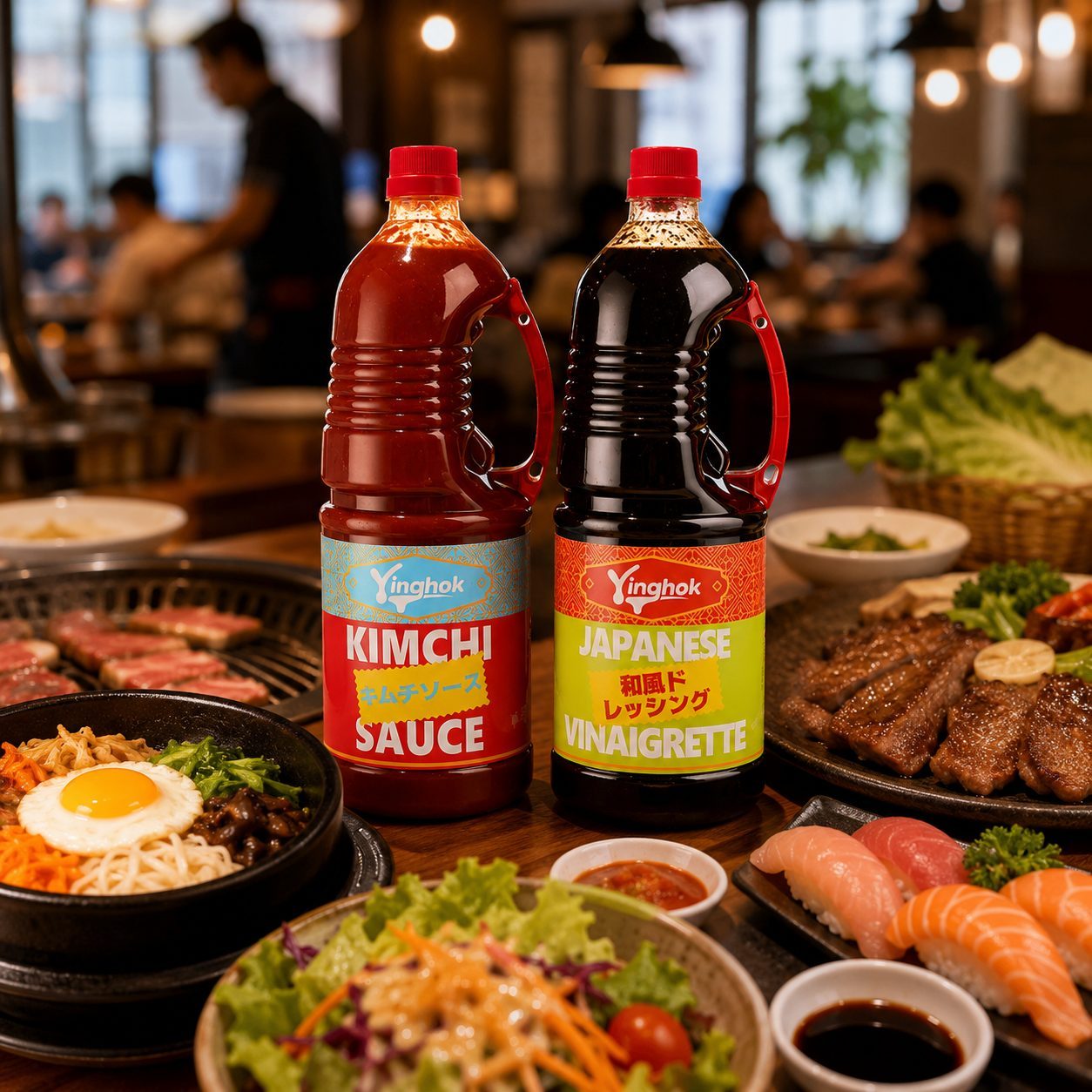
Fill volume, headspace and closure are specification lines, not packaging afterthoughts: a sauce that passes a bench test can still fail at goods-in on a 4 mm fill shortfall.
How Do You Specify a Fermented Kimchi Sauce Differently From an Emulsion Dressing?
Both sit on one category page and arrive in the same enquiry, yet they belong to different engineering families. A Korean-style kimchi sauce is a fermented chilli base in which acidity and salt keep moving after filling. A vinaigrette or a wasabi salad dressing is an emulsion, where the risk is phase separation rather than acidification.
Different failure modes mean different acceptance tests: one shared QC sheet either passes a dressing that splits in month five, or rejects a good kimchi batch for drifting as designed.
The rows below are the lines that diverge first; fill, closure, label version and lot coding stay on the shared template.
| Specification line | Fermented kimchi sauce | Emulsion dressing | Why it matters at goods-in |
|---|---|---|---|
| Primary ageing risk | Continued acidification, water release | Phase separation, oiling-off | The two cannot share one rejection rule |
| Parameter to write first | Acidity window plus salt level | Viscosity at two temperatures | One number per system, each with a tolerance |
| Colour reference | Chilli red held against a physical chip | Opacity and gloss of the emulsion | A phone photo is not a reference standard |
| Sensory check | Fermented depth and heat, agreed at pilot | Acid-to-oil balance, mouth-coating | Belongs in the sheet but never replaces a number |
| Changeover risk | Chilli residue and colour carry-over | Oil film and emulsifier carry-over | Cleaning sequence becomes part of the spec |
| Typical foodservice pack | 1.8 L, 2 kg, 3.78 L, 18 L | 1 L to 3.78 L, 18 L | Pack format sets fill tolerance and closure check |
Starting points taken from the specs published on our own salad and kimchi SKUs; the figures for any single programme are fixed in its signed specification, not taken from this table.
Which Parameters Need a Tolerance, and Which Need a Method?
A tolerance without a method is an argument waiting to happen. If the sheet says salt 4.0% ± 0.3% but never says how salt is measured, a buyer testing by refractometer and a factory testing by titration can both be right and still disagree.
Every measured line carries the number, the tolerance, and the method or instrument family. The figures stay open until pilot approval.
| Parameter | Unit on the sheet | Tolerance band | Method statement | Status for a new programme |
|---|---|---|---|---|
| Acidity, kimchi style | % as lactic acid | Window agreed at pilot | Laboratory titration, in-house method | To be confirmed per recipe |
| Salt content | % w/w | ±0.2 to 0.3 points | Same instrument family both ends | To be confirmed per recipe |
| Viscosity | mPa·s or flow time | Same reading at 20°C and 5°C | Named instrument, spindle or cup stated | To be confirmed at pilot |
| Fill volume | ml per pack | Filler repeatability, not label | In-line check weigher plus manual sample | Fixed once the line is chosen |
| pH, dressing | pH units | One decimal place | Calibrated meter, temperature noted | To be confirmed at pilot |
| Net weight | g or kg per case | Per case, logged per pallet | Scale check, ten cases per pallet | Fixed with pack format |
The table refuses to invent a number for a recipe nobody has run. A new programme starts with “to be confirmed” in the tolerance column and fills it at pilot approval, both parties testing the same sample on the same day.
Dressings need one extra line kimchi sauces rarely need: a rest statement. An emulsion that reads correctly off the filler can separate in 24 hours, so viscosity is measured after a defined rest period rather than immediately after filling.
How Many SKUs Should a Range Hold Before the Specification Becomes Unmanageable?
The honest answer from a manufacturing side is fewer than most buyers start with. Every extra SKU multiplies documents, label versions, allergen checks and changeovers, and multiplies nothing on the shelf. A range that reads as complete usually runs on five to seven.
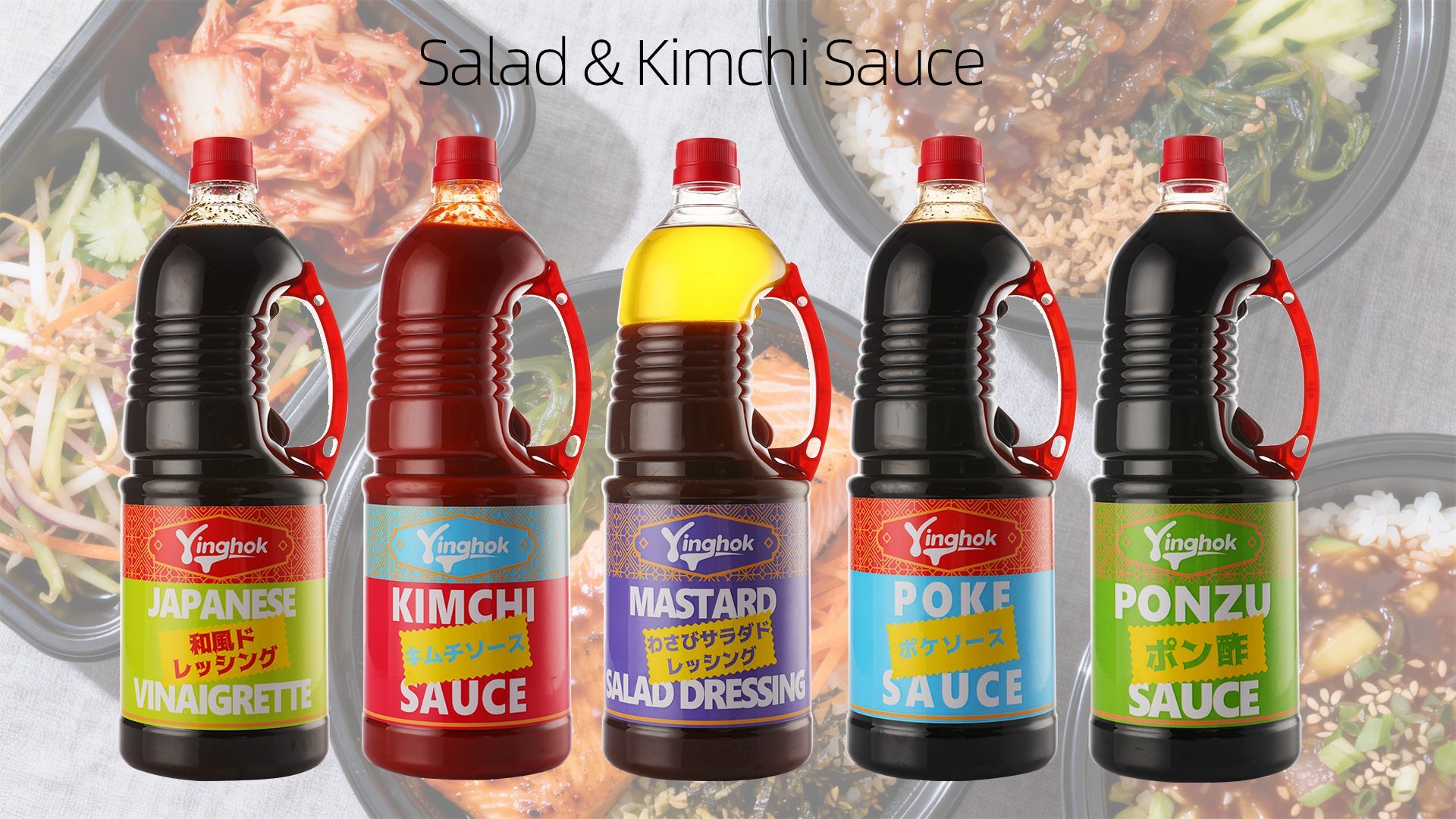
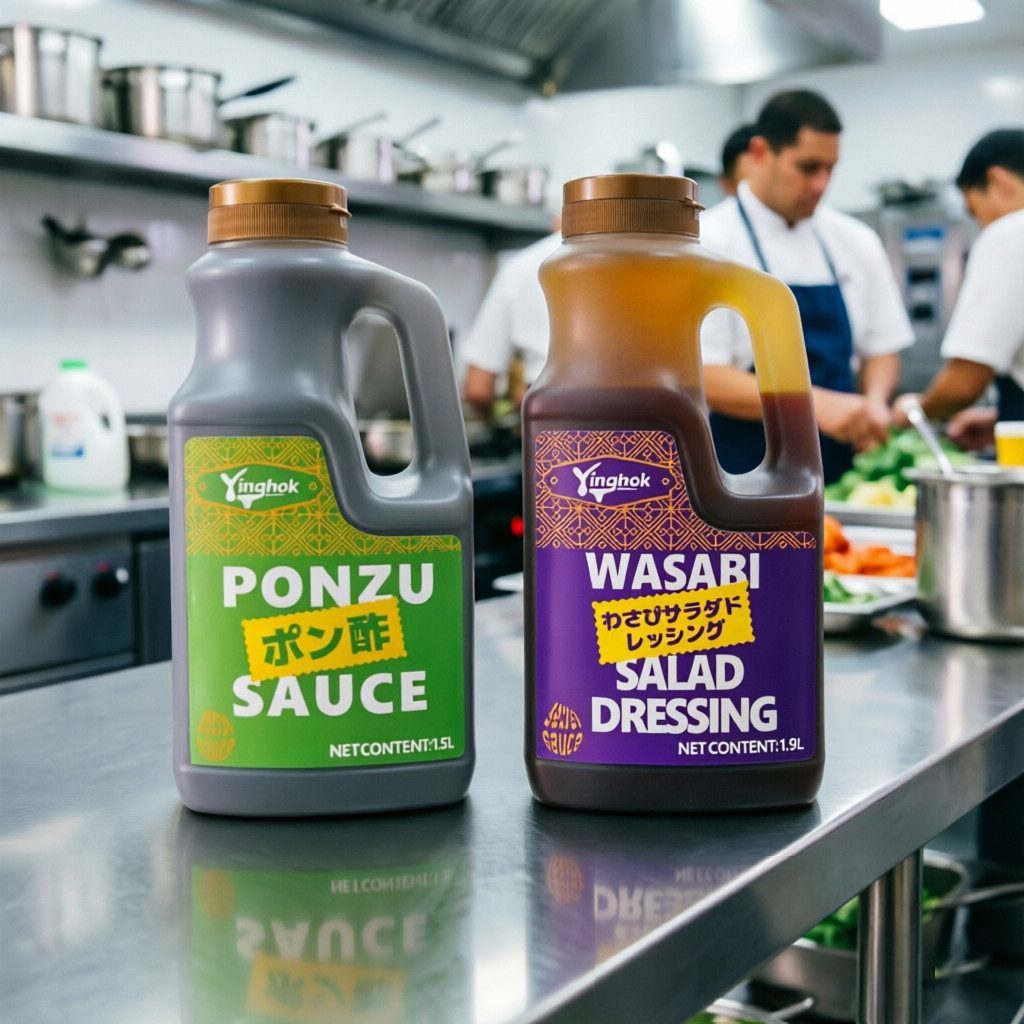
Our own salad and kimchi group runs on seven published products: a Japanese vinaigrette, a halal wasabi dressing, a Hawaiian poke sauce, a citrus-soy ponzu, two kimchi sauces for different factory use cases, and a tempura dip. Each has a role and its own document.
- One SKU, one job. If the sentence “this sauce exists because the menu needs…” cannot be finished, the item is a variant.
- One pack, one fill line. A 180 ml bottle and an 18 L drum of one recipe need two documents: fill tolerance, closure and shelf expectation differ.
- One claim, one evidence file. Halal, organic or an allergen-free statement each add a document. Stack three claims on a SKU and the paperwork outgrows the sales.
Trimming a launch range from twelve to seven SKUs removes five label approvals, five QC sheets and five changeovers from the first production cycle.
How Do Pack Format and Fill Volume Change the Sauce Inside?
Pack format is not a container decision taken after the recipe is fixed; it changes what the recipe must do. A 180 ml bottle is opened, used across weeks and closed again, so it needs a viscosity that pours from a narrow neck and a colour stable in clear glass. An 18 L drum is decanted by a kitchen and emptied within days, so colour fade matters less and heat exposure during decanting matters more.
Our published ladder runs from 180 ml, 200 ml, 230 ml, 260 ml, 300 ml and 450 ml bottles, through 1 L, 1.75 L, 1.8 L, 1.9 L and 2 kg foodservice units, to 3.78 L jugs and 18 L drums. Not every SKU is offered in every size: the pack has to be justified by the use case.
- Declare the fill, not the bottleA 1.8 L container filled to 1,760 ml is compliant only if the declaration says so. State ml per pack and the headspace allowance.
- Fix the closure checkState the torque range and the vacuum or seal test. A sauce that leaks in transit is a packaging failure blamed on the sauce.
- Name the storage condition per pack sizeEvery SKU is documented for a cool, dry place, yet a bottle and a drum do not see the same heat on the route.
A useful test: ask for the specifications of two pack sizes of one recipe. If they are identical except the millilitre figure, fill and closure logic was never thought through.
Label version, language set and fill declaration are checked together at goods-in.
Which Claims Need Their Own Evidence File Before the First Order?
Every claim on the label creates an obligation that belongs to the brand holder, not the factory. The workable split: the factory holds valid certificates for site and process, the brand confirms the finished product sits inside their scope.
Our site documentation covers BRC, HACCP, FDA and halal certification, published on the company and certification pages. What matters in a specification is scope: a halal and a non-halal line in one plant need a documented changeover and sourcing controls.
BRC, HACCP, FDA registration and halal certification, each current on the shipment date, not only on the order date.
Microbiological and, where required, nutritional reports for the finished product, tied to a batch or a production window.
Full compositional statement including allergens, plus any market-specific declaration your import point requires.
Written sequence for allergen-containing to allergen-free, or halal to non-halal, production on one line.
Two failures recur. A certificate expiring inside a long production window is valid at order and invalid at loading. A claim copied from a similar SKU without checking scope fails at the border. Write the expiry and the scope sentence into the sheet.
How Long Does a Custom Programme Take From Brief to Pallet?
On our production calendar a custom salad and kimchi programme runs 35–45 days from the date approved specification and artwork are released. The clock starts when both documents are signed, not at enquiry or purchase order.
A buyer who counts from the PO plans a launch one or two weeks early, and pays for the gap in air freight.
| Calendar stage | Owner | Output | Date basis |
|---|---|---|---|
| Brief and recipe direction | Buyer plus factory R&D | Target profile, pack, market | Buyer timeline, factory clock not started |
| Pilot sample and tasting | Factory R&D, buyer panel | Approved sample reference | Signed sample date |
| Specification and artwork release | Buyer QA, brand owner | Signed sheet, approved label | Clock starts here |
| Bulk production and filling | Factory production | Batch records, fill and closure checks | Inside the 35–45 days |
| QC release and packing | Factory QC | Batch release certificate | Inside the 35–45 days |
| Shipping and clearance | Forwarder, importer | Arrival at warehouse | Outside the window |
Production window shown is our standard commitment of 35–45 days from approved specification and artwork; transit and market-specific certification lead time are additional.
If label artwork is still in revision when the specification is signed, the window effectively starts at the later date. That is why the sheet carries the artwork version beside the recipe version: one line, one less surprise. A seven-SKU range also ships in waves rather than as one event, and the wave plan belongs in the same conversation.
How Do You Compare Suppliers When Every Sample Tastes Acceptable?
Samples are the easiest part of sourcing and the least predictive. Any supplier can make an acceptable 500 ml sample, because a sample gets attention. What separates them is repeating it at 3,000 kg in month four, and proving it with records.
- Show three batch records for a comparable SKUThe parameters that matter are the ones that vary, and a supplier who tracks them produces the records in an afternoon.
- What is your changeover sequence between the chilli line and the dressing line?An answer that stops at “we clean” is not a sequence. Ask for the stage order and the verification step.
- Which date does your lead time count from?Order, deposit or approved specification, then ask for the last three shipment records against a comparable order.
- Who signs the acceptance test, and what do they test?A name and a two-line method means a working QC gate. “Our QC team checks quality” means there is none.
These four treat the plant as evidence and the sample as a brochure, and make the comparison equal: the thin answer is visible without tasting a fifth sample. Our pre-shipment supplier audit walkthrough lists the documents to request.
Where Does the Specification Break First Once Production Starts?
In the first ninety days the specification is most often broken by a change nobody wrote down: a pack substitution because the 1.8 L bottle ran short, a storage move to a warmer bay, a line reassignment that put kimchi sauce on a filler last used for a darker product. Each is a legitimate decision and each silently rewrites the sheet.
A different supplier of the same nominal 1.8 L container changes fill height and closure behaviour. A container change is a revision, not a purchasing convenience.
Two warehouses, one “cool, dry place” note. Write a temperature band and a named owner per location.
Chilli colour and oil residue carry over. If the line changes, the changeover verification changes with it.
A new chilli source can move acidity and heat together. Require notification before any source change.
The countermeasure is a revision clause, not more vigilance: any change to container, line, storage location or raw material source requires a written revision and a re-check of the affected parameters. One clause, reviewed at ninety days, is enough.
What Distinguishes a Specification-Driven Order From a Sample-Driven One?
A sample-driven order is settled by taste and memory. A specification-driven order is settled by a signed sheet, three batch records and a date basis. A well-run order travels with five document types, and asking for all five at specification stage prevents the scramble at the port.
- Batch release certificate per lot, listing the parameters tested and results against the agreed window.
- Certificate of analysis where the market requires it, tied to the lot number printed on the case.
- Compositional and allergen statement matching the approved label version exactly, including “may contain” wording.
- Certification copies valid on the shipment date, with scope covering the finished product.
- Commercial set: invoice, packing list and the transport documents your forwarder needs.
The common failure is version mismatch: the label approved in month one, the statement issued in month two and the certificate valid in month three describe one product only if someone checks the three numbers together. Put them on one line. Across a range, keep the pack per SKU: one combined certificate for seven products satisfies nobody.
Batch records are the specification's evidence trail: the parameters that vary between batches are the only ones worth a tolerance.
The second costs a few hours of paperwork and saves the renegotiation, the re-shipment and the shelf-stability argument. It also survives a change of staff on both sides.
The discipline is not new. BLOSSOM CHEER, a custom door and window manufacturer, has held the same principle for 30+ years in another industry: open the drawings, fix the tolerances, agree the date basis, then build. A sauce line applies that logic to acidity, fill volume and changeover.
We have run custom sauce programmes from our Dalian and Foshan plants since 2001, with OEM and ODM work across Japanese, Korean and international menus. The first step for a new programme is not a price: it is a specification draft both sides can mark up.
Pack sizes, target market, menu role and first-order volume are enough to start. We will return a draft specification with the parameters we can fix immediately and the ones that need a pilot, plus a 35–45 day production window counted from your approval date.
Salad & kimchi saucesRamen soup basesSushi saucesAbout our plants
Should the specification be written before or after the pilot sample is approved?
Draft it before, sign it after. The draft tells the pilot what to measure; the approved sample fills the tolerance column. A sheet written only after approval usually omits what nobody thought to measure.
How many pack sizes should one kimchi sauce recipe launch with?
Two: one retail or table-service size and one foodservice size. Each extra size needs its own fill, closure and shelf statement, and a range starting with five sizes usually ends with three.
Can a halal salad dressing and a chilli kimchi sauce share one line?
Yes, with a documented changeover sequence and sourcing controls. Ask for the changeover protocol and confirm the halal certificate scope names the finished product.
What shelf life should be written into the specification?
Use the published figure: 18 months on the kimchi sauces, the vinaigrette and the ponzu, 12 months on the wasabi dressing, the poke sauce and the tempura dip. That is unopened shelf life, not the window after opening.
What does the 35–45 days include?
Bulk production, filling, labelling, case packing and QC release, counted from release of approved specification and artwork. Transit, label redesign and market-specific certification lead time sit outside it.
How do I handle a recipe change after production starts?
Treat it as a specification revision: change the version number, re-test the affected parameters at pilot scale, and state which shipments the new version covers. An email-only change is how a compliant product turns non-conforming.